
In modern industrial production, temperature measurement has become a universal requirement for product quality control. Traditionally, enterprises have relied on host-based data acquisition systems — centralized units that manage measurement boards through plug-in cards or terminal panels. While these systems address the basic need for data acquisition, they are inherently bulky, power-intensive, require centralized wiring, and offer limited measurement accuracy. When applications demand multi-point synchronization, high precision, or long-distance deployment in complex industrial environments, conventional DAQ systems quickly prove inadequate. This is precisely the market pain point that Smartgiant set out to address with the introduction of NeoDAQ — a distributed intelligent data acquisition system engineered to overcome the three critical limitations of host-based DAQ architectures.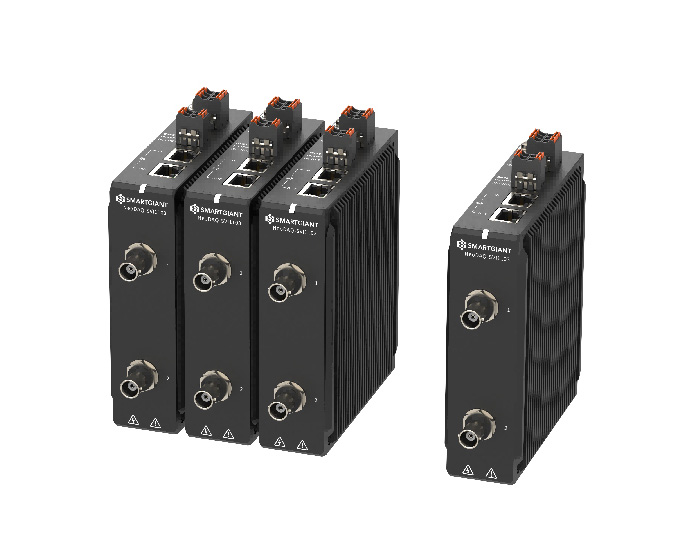
I. Pain Points of Host-Based DAQ in Temperature Measurement
Host-based DAQ systems have revealed significant shortcomings in real-world applications, making them ill-suited to meet the complex demands of modern industry. The primary pain points include:
1. Insufficient Measurement Capability
Traditional DAQ systems are constrained by the resolution and signal-to-noise ratio of their analog inputs — typically 16-bit — making it difficult to achieve high-precision measurements within ±0.1°C. Fixed measurement ranges also pose challenges for wide-range temperature applications (e.g., −40°C to +200°C), requiring multiple range switching operations that reduce overall system efficiency.
2. Lack of Deployment Flexibility
Host-based DAQ architectures require all sensors to be wired centrally to a master control unit. When measurement points are widely distributed or located at significant distances, cabling costs escalate and susceptibility to electromagnetic interference increases. Mixed-signal acquisition — supporting thermocouples, RTDs, analog signals, and digital signals simultaneously — is poorly supported, often necessitating complex external signal conditioning circuits.
3. Inadequate Environmental Adaptability
Host-based DAQ units are large, power-hungry, and difficult to deploy in the field. Their low ingress protection (IP) ratings prevent reliable long-term operation in harsh industrial environments characterized by elevated temperatures, high humidity, mechanical vibration, or electromagnetic interference. Integration into on-site equipment or embedded test systems is equally challenging.
II. NeoDAQ: An Innovative Solution to These Challenges
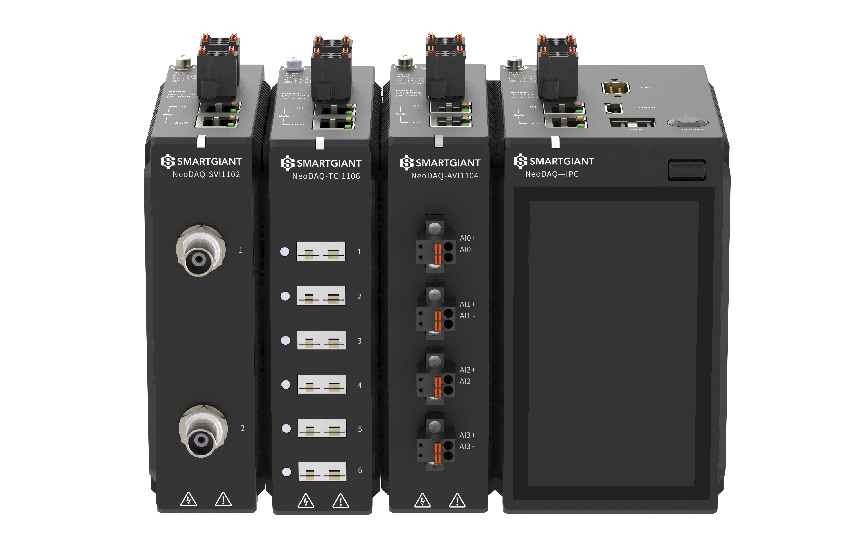
In response to these industry-wide challenges, Smartgiant has developed NeoDAQ — a distributed intelligent data acquisition system purpose-built for demanding industrial temperature measurement applications. NeoDAQ delivers the following key capabilities:
1. Superior Measurement Performance
NeoDAQ supports thermocouple input ranges up to ±80 mV and RTD input ranges up to 4 kΩ, covering the vast majority of industrial temperature measurement scenarios. With a 24-bit ADC resolution, the system captures even the most subtle temperature variations with exceptional accuracy. Each module features an 8-channel design, making it ideally suited for multi-channel synchronous temperature acquisition.
2. Flexible and Scalable Deployment
NeoDAQ adopts a distributed, modular architecture in which individual measurement modules can operate independently across dispersed locations, while transmitting data back to a central system via LAN or USB interfaces for unified analysis. For multi-parameter measurement scenarios, users can simply select the appropriate functional modules — no additional external signal conditioning circuitry is required.
3. Strong Environmental Adaptability
NeoDAQ is designed to industrial-grade standards, ensuring stable and reliable long-term operation in demanding environments. Its compact, portable, and modular form factor enables rapid deployment across laboratory, production line, and outdoor testing settings. Customization services are also available to meet application-specific measurement requirements.
III. NeoDAQ in Action: Industrial Motor Temperature Monitoring
Taking industrial motor temperature monitoring as a representative example:
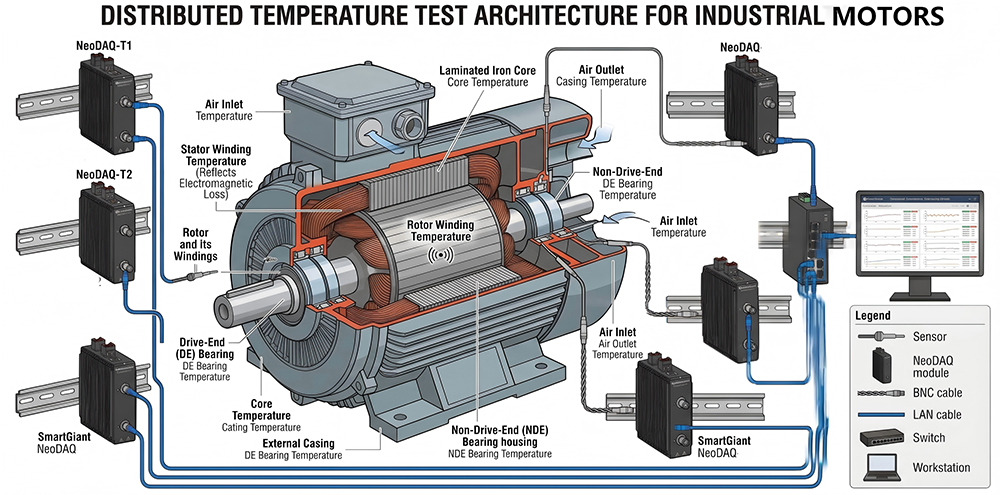
A typical electric motor has 13 critical temperature measurement points, including the stator windings, rotor windings, bearings, motor housing, and air inlet/outlet. These points are spatially distributed across the motor, making comprehensive coverage difficult for traditional host-based DAQ systems.
With NeoDAQ, distributed temperature measurement modules are deployed in close proximity to each measurement point. Multiple NeoDAQ modules connect to sensors via BNC cables, and the acquired data is aggregated through an industrial Ethernet switch over LAN before being transmitted to a workstation for real-time multi-channel display and analysis.
This distributed architecture enables comprehensive and precise monitoring of temperature variations across all motor zones, providing a complete data foundation for thermal diagnostics, fault prediction, and performance evaluation.
IV. Conclusion
As demonstrated throughout this article, NeoDAQ offers a compelling solution for industrial temperature measurement — whether capturing weak thermocouple or RTD signals through high-resolution ADCs, or meeting the rigorous demands of industrial testing through multi-channel synchronous acquisition and robust EMI immunity. NeoDAQ precisely addresses the core requirements of high-fidelity, high-synchronicity, and high-reliability data acquisition, resolving the fundamental limitations of host-based DAQ systems in temperature monitoring applications. It represents the premier choice for modern industrial temperature measurement.